Trump Claims US Will Guard Strait of Hormuz, Charge Toll
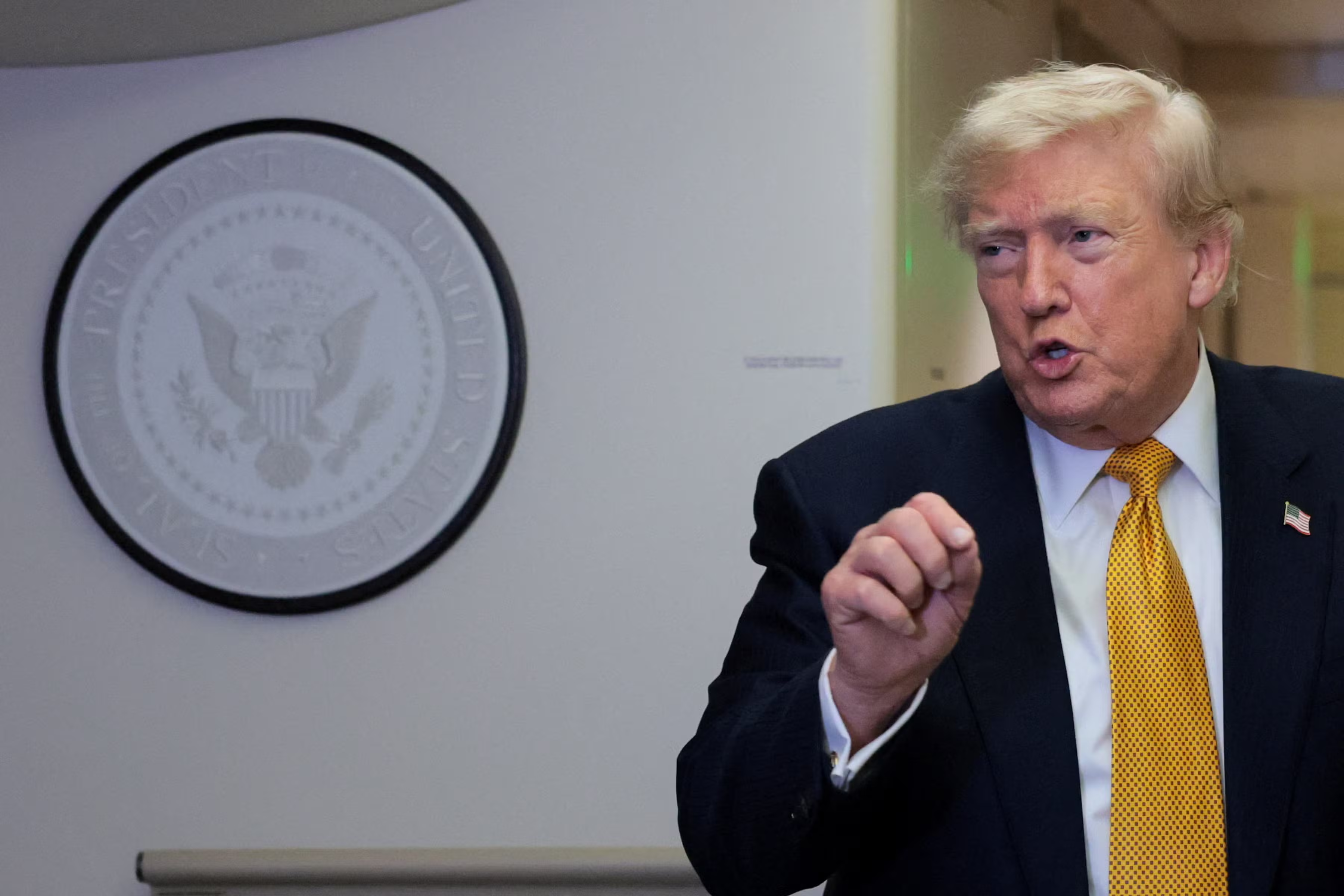
U.S. President Donald Trump declared on Monday, July 13th, that the United States will "take control" of the Strait of Hormuz and impose a 20% toll on all cargo passing through the vital waterway. Trump stated that the U.S. would become the "guardian of the strait" and should be reimbursed for ensuring security in the volatile region. He proposed charging 20% of all cargo to cover these costs. This statement marks a significant shift from Trump's previous remarks, particularly those made since the preliminary peace agreement with Iran in mid-June. At that time, Trump had repeatedly stated that no tolls would be charged on the Strait of Hormuz. The text of the preliminary peace memorandum signed by the U.S. and Iran also contradicts his latest declaration. Earlier statements from Trump included assurances on June 15th that "Hormuz will have no toll," and on June 20th, he suggested tolls might be imposed by the U.S. as reimbursement only if a final peace deal wasn't reached, while also reinforcing a 60-day toll-free period as per the preliminary document. On June 24th, Trump reiterated that Iran had assured him there would be no tolls, dismissing reports of "fake news" and threatening to end negotiations otherwise. Iran's military command immediately rejected Trump's claim, asserting that Iran would not permit U.S. intervention in the administration of the Strait of Hormuz and warning that any U.S. transit without Iranian authorization would be met with strong resistance. Iran also cautioned regional countries, stating that cooperation with the U.S. would be considered an act of war against Iran. The Iranian Revolutionary Guard Corps affirmed its authority and control over the strait, threatening that U.S. interference jeopardizes global oil and gas supply security. Iran also claimed the Strait of Hormuz had been closed since Saturday, July 11th, a claim denied by the U.S., following U.S. strikes on Iranian military targets. The U.S. stated these strikes were retaliation for Iranian attacks on vessels, while Iran confirmed firing warning shots and detaining a vessel for compromising maritime security. The Iranian Revolutionary Guard declared the Strait would remain closed until further notice. The U.S. conducted further strikes on Sunday, July 12th, to degrade Iran's capacity to attack vessels, prompting retaliatory attacks from Iran against Bahrain, Kuwait, Qatar, Jordan, and Oman. The President of the Iranian Parliament stated that "the era of unilateral deals is over" and that Iran would demand consequences for broken promises.
This situation highlights the complex geopolitical dynamics surrounding a critical global energy chokepoint. President Trump's assertion of U.S. guardianship and toll collection represents a potential unilateral shift in maritime security governance, contrasting with established international norms and previous diplomatic agreements. Such a move could create significant friction, not only with Iran, which views the strait as under its sovereign purview, but also with other regional and international actors reliant on unimpeded passage. The conflicting statements from the U.S. administration suggest internal policy debates or strategic signaling, while Iran's firm rejection and retaliatory posture underscore its determination to defend its perceived interests. The potential for escalation, given the military actions and rhetoric from both sides, poses a substantial risk to global energy markets and regional stability. Looking ahead, the long-term implications depend on whether diplomatic channels can de-escalate tensions or if a new framework for maritime security and transit fees in the Strait of Hormuz will emerge, potentially driven by evolving power balances and technological advancements in energy transport.
AI-generated to prompt reflection — not editorial opinion, not advice, not a statement of fact. How this works.