Trump Demands Last-Minute Changes to Under-Construction White House Helipad
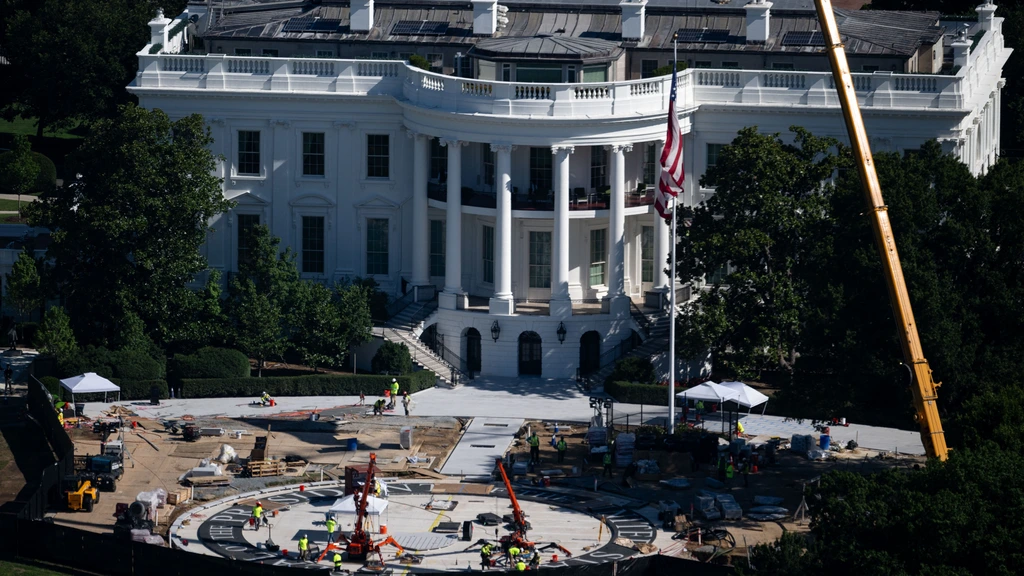
President Trump has reportedly ordered significant last-minute alterations to a new helipad being constructed at the White House, according to anonymous government officials speaking to The Washington Post. The core issue appears to be the slight incline of the platform, which Trump allegedly wants to be perfectly horizontal. While a minor slope is standard for drainage, sources claim the President desires a completely level surface. Photographs analyzed by the newspaper show that a granite top layer, featuring the presidential seal, has already been demolished and will need to be redone. Construction workers had only recently begun installing this 30-meter-wide surface. The project, announced by Trump in early July, has involved round-the-clock work, with the White House reportedly aiming for completion before Chinese President Xi Jinping's visit in late September. The initial $5 million cost, funded by Lockheed Martin (owner of helicopter manufacturer Sikorsky), is expected to increase due to these modifications, though the exact financial and timeline impacts remain unknown. The new helipad is necessary because the VH-92A helicopter used by the President can scorch the existing lawn, which was also previously unsuitable due to its own excessive slope. Until the new platform is finished, Trump is using a section of ground south of the White House for landings. A White House spokesperson declined to comment on the specific changes but stated that the White House has 'never looked better' under Trump's leadership and will 'only get better.' This follows another controversial renovation where Trump ordered the demolition of the East Wing to build a larger ballroom, a project that faced temporary halts due to historical preservation concerns.
This event highlights the intersection of presidential prerogative and large-scale infrastructure projects within the White House complex. The reported demand for a perfectly horizontal helipad, overriding standard engineering practices for drainage, suggests a focus on aesthetic or symbolic perfection over functional optimization. This preference could stem from a desire for a visually flawless environment, potentially influencing future design decisions in public or governmental spaces. The financial and temporal implications of such mid-construction changes, especially under pressure for a high-profile state visit, underscore the challenges of managing complex projects with evolving requirements. Such instances prompt consideration of governance frameworks for presidential facilities, balancing immediate executive desires with long-term operational efficiency, cost-effectiveness, and adherence to established best practices in construction and engineering.
AI-generated to prompt reflection — not editorial opinion, not advice, not a statement of fact. How this works.
