Trump's Power Claims Spark Debate on US Presidential Authority
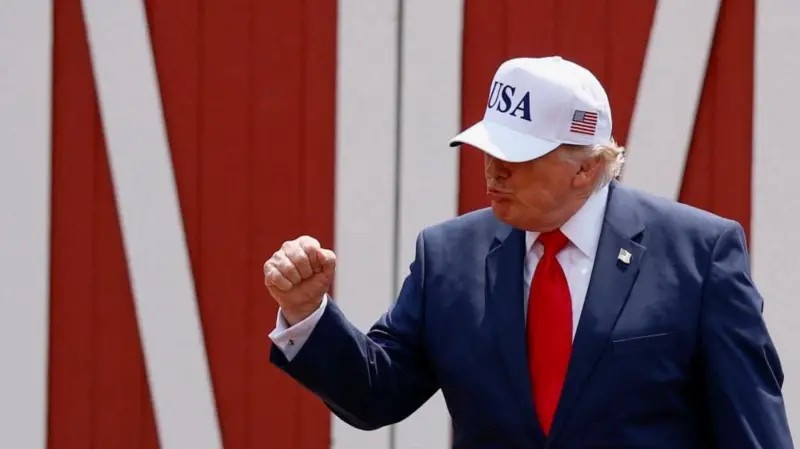
As the United States approaches its 250th anniversary, President Donald Trump has reignited discussions about the limits of presidential power. Trump, known for his displays of personal authority, has surrounded himself with loyalists, publicly criticized world leaders, and pressured major American corporations. He recently stated in an interview that there are "no limits" to his power, a sentiment critics argue contradicts the nation's founding principles of independence from monarchical rule. Millions have protested Trump, carrying signs emphasizing democracy over monarchy and asserting the primacy of the Constitution. Critics point to instances where Trump has bypassed Congress, such as initiating military action in Iran without authorization and keeping legislators uninformed about operations in Venezuela. He also used emergency powers to impose global tariffs, a move later deemed unconstitutional by the Supreme Court. Furthermore, accusations have arisen that Trump has used the Department of Justice to target political adversaries, blurring the lines between the White House and federal prosecutors, a separation established after the Watergate scandal. Despite these criticisms, Trump was elected on a platform of significant policy changes, and a majority of Republicans, about 80%, reportedly support his performance. However, his overall approval rating has fallen below 40%.
The ongoing debate surrounding President Trump's assertions of power and the historical context of executive authority in the United States highlights a persistent tension within the American governance system. The nation's founders grappled with concentrating power, leading to a system of checks and balances designed to prevent any single branch from becoming too dominant. Trump's actions and rhetoric, while drawing parallels to past presidents who sought to expand executive influence, are perceived by critics as pushing these boundaries further. This situation prompts an examination of whether current institutional frameworks are sufficiently robust to manage the evolving dynamics of presidential power in an era of rapid information dissemination and intense political polarization. The challenge lies in upholding constitutional principles while adapting to contemporary political realities and ensuring accountability without undermining the necessary functions of the executive branch.
AI-generated to prompt reflection — not editorial opinion, not advice, not a statement of fact. How this works.