Trump's White House Correspondents' Dinner Speech: A Mix of Conciliation and Criticism
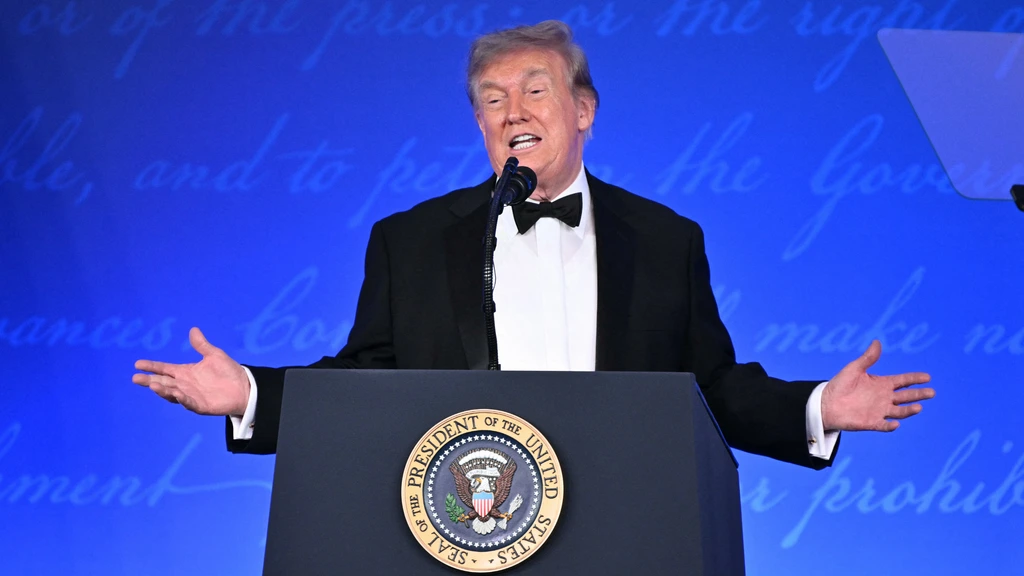
Donald Trump's speech at the White House Correspondents' Dinner was intended to be more conciliatory than usual, following a previous disruption to the event. He began by expressing respect for all attendees and emphasizing the importance of free speech and debate over political violence. However, this measured tone was short-lived, as Trump quickly reverted to accusations of fake news, targeting reporters and Democratic politicians. The audience appeared largely disengaged by his meandering remarks. Security at the event was noticeably heightened, with a single entry point, K9 units, metal detectors, and armed Secret Service agents. Trump, who had previously boycotted the dinner, was the primary speaker, as no stand-up comedian was present. He did face some subtle critiques, including an AI-generated video from a Founding Father highlighting the necessity of a free press unfettered by government. Trump initially acknowledged the importance of the event and complimented various journalists, referencing the previous violent disruption. Yet, he soon pivoted to attacking celebrities, Democrats, and journalists he accused of spreading fake news. He also discussed his complex relationship with the press, sharing anecdotes about his direct phone number being distributed and his frequent, though sometimes ignored, calls with reporters. He reasoned that engaging with the press, even with the risk of misinterpretation, offered a better chance for positive coverage than complete avoidance. The strained dynamic was further illustrated when Trump reacted with a shrug to an award for reporting on his association with Jeffrey Epstein, suggesting his presence generated significant media attention and revenue for outlets like The New York Times. He peppered his speech with past insults aimed at CNN and The New York Times, criticized specific journalists like Kaitlan Collins and Don Lemon, and made disparaging remarks about political rivals' weight and Joe Biden's memory. A joke about the age of politicians, which he had to explain, fell flat, leading him to lament its reception. Despite the uneven performance, Trump stated his intention to return the following year, unless the press became even more hostile, and humorously hinted at a 2028 presidential run with a cap. He concluded by expressing that the evening was more challenging than he had anticipated.
The White House Correspondents' Dinner, historically a venue for presidents to engage with the press through humor and self-reflection, presented a complex dynamic with Donald Trump. His speech oscillated between overtures of respect for free speech and sharp criticisms of the media, reflecting a persistent tension between the executive branch and journalistic institutions. The heightened security underscores the prevailing climate of concern surrounding public events. From a systems perspective, the event highlights the inherent conflict between the political imperative to control narrative and the journalistic function of holding power accountable. Future iterations of such events may need to navigate evolving communication technologies, including AI, and adapt to changing societal expectations regarding political discourse and media trust. The underlying incentive structures for both politicians and journalists remain a critical factor in shaping their interactions.
AI-generated to prompt reflection — not editorial opinion, not advice, not a statement of fact. How this works.