Tsinghua University releases VeriLoop Coder-E1 for automated code repair
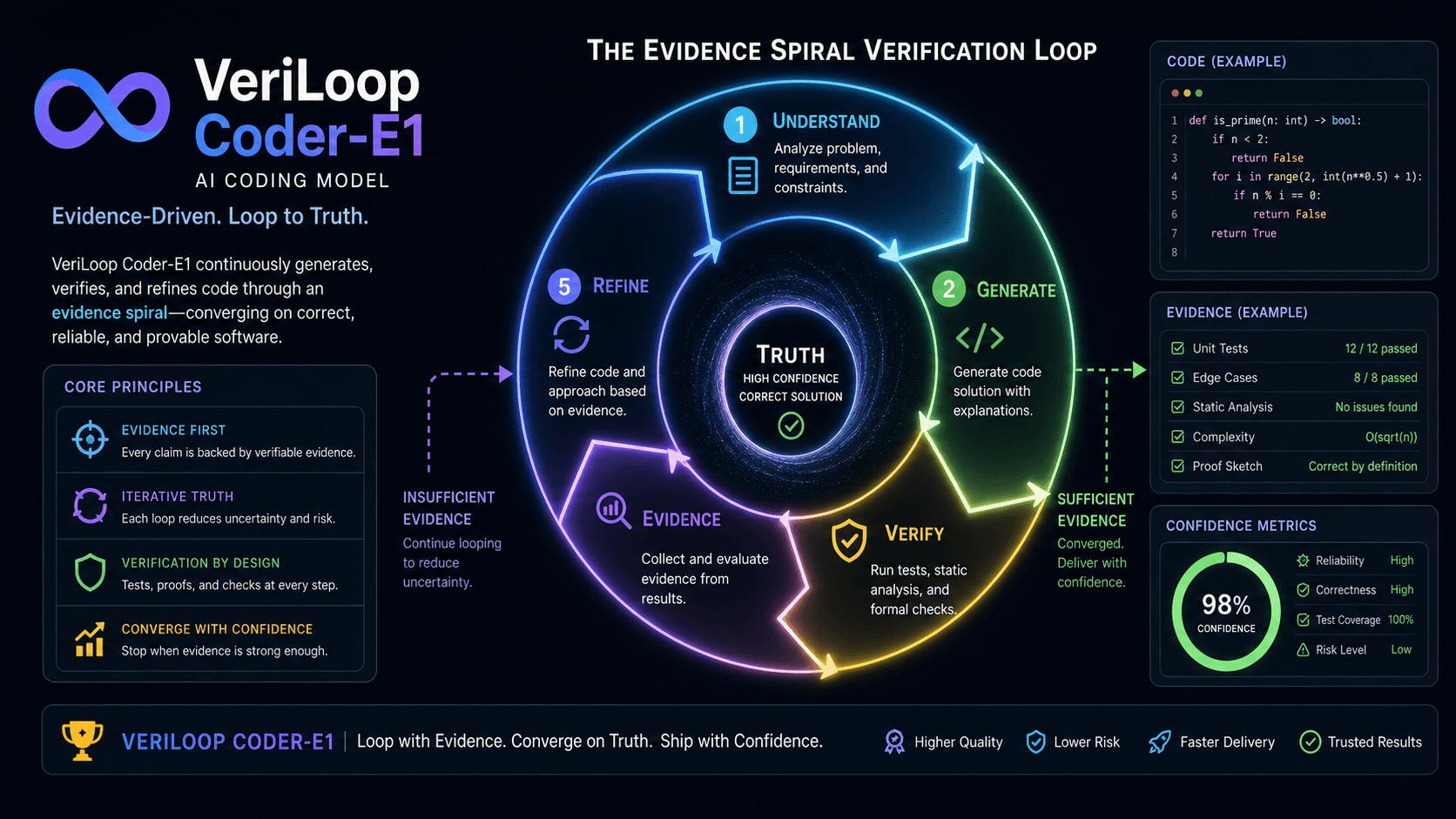
Researchers from Tsinghua University have open-sourced VeriLoop Coder-E1, an AI model designed for repository-level code repair. This model is built upon the Qwen3.6-27B architecture and incorporates techniques like narrow-domain PEFT (Parameter-Efficient Fine-Tuning) and Self-Harness. VeriLoop Coder-E1 leverages an evidence-governed spiral approach to drive verifiable recursive self-improvement. The model has demonstrated strong performance on several benchmarks, achieving a score of 85.20 on SWE-bench Verified. It also scored 62.38 on SWE-bench Pro and 76.40 on Terminal-Bench 2.0. In the DeepSWE benchmark, VeriLoop Coder-E1 achieved a score of 33.63. These results highlight the model's capabilities in automated code maintenance and improvement.
The release of VeriLoop Coder-E1 by Tsinghua University signifies a step forward in the domain of automated code repair, particularly at the repository level. By open-sourcing this model, the researchers are fostering collaboration and accelerating innovation within the AI development community. The model's performance on benchmarks like SWE-bench suggests a growing maturity in AI's ability to understand and modify complex codebases. Looking ahead, the integration of such advanced code repair tools could significantly impact software development lifecycles, potentially reducing development costs and improving software reliability. However, the long-term implications for developer roles and the challenges of ensuring AI-generated code aligns with human intent and security standards will require ongoing consideration and robust validation frameworks.
AI-generated to prompt reflection — not editorial opinion, not advice, not a statement of fact. How this works.