Two logic games inspired by Minesweeper and Wordle offer new challenges
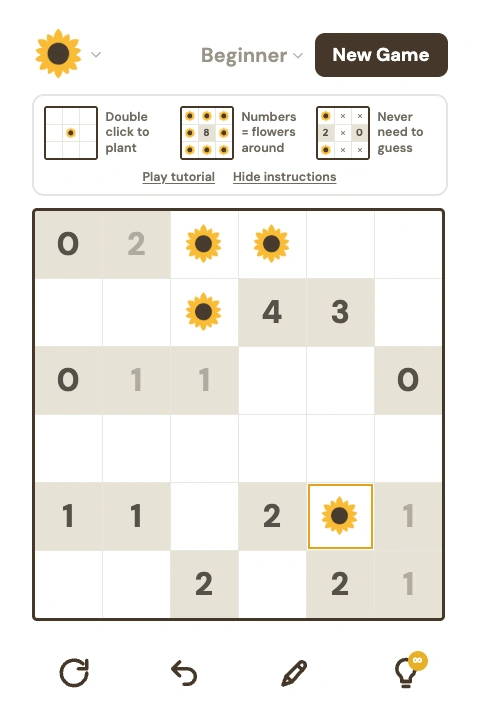
Two new logic games, Sunflowers and Hilo, offer engaging challenges inspired by classic games like Minesweeper and Wordle. Sunflowers reimagines Minesweeper by having players plant sunflowers instead of avoiding mines. In this game, numbers indicate how many sunflowers are in the surrounding eight squares, and the objective is to logically deduce the placement of all sunflowers on the board. The game guarantees that no guessing is required, similar to well-constructed Sudoku puzzles. It features five difficulty levels that increase in board size and introduce more complex logical reasoning techniques. An internal engine analyzes each puzzle to classify the logical skills needed for its solution. Sunflowers includes helpful features like automatic filling of empty squares around a clue and a three-life system that penalizes only incorrect sunflower placements.
Hilo, pronounced "High-Low," combines elements of Wordle with "before or after" clues. It presents daily challenges where players must guess a seven-letter English word within five attempts. Unlike Wordle, Hilo provides clues about the alphabetical position of the correct letters. An upward arrow indicates the target letter is later in the alphabet, while a downward arrow signifies it's earlier. Correctly guessed letters are highlighted in green. The game displays a range of possible letters for each position as a helpful guide. While players typically use the provided letter ranges, they may sometimes need to guess incorrect letters to deduce others. All players receive the same daily word, and a historical archive allows practice with previous puzzles.
These logic games leverage familiar mechanics from Minesweeper and Wordle, adapting them to offer novel deductive challenges. The design of Sunflowers, emphasizing pure logic without guesswork, aligns with a growing demand for mentally stimulating digital entertainment that avoids reliance on chance. Hilo's approach, integrating alphabetical sequencing into a word-guessing format, introduces a unique cognitive layer. The inclusion of difficulty scaling and historical archives suggests a strategy to foster sustained user engagement by catering to varied skill levels and providing opportunities for iterative improvement. As AI continues to advance, games that test pure logic and deduction may see increased popularity, offering a counterpoint to more computationally driven or visually immersive experiences.
AI-generated to prompt reflection — not editorial opinion, not advice, not a statement of fact. How this works.