Uganda's Minister of Education's LinkedIn Profile
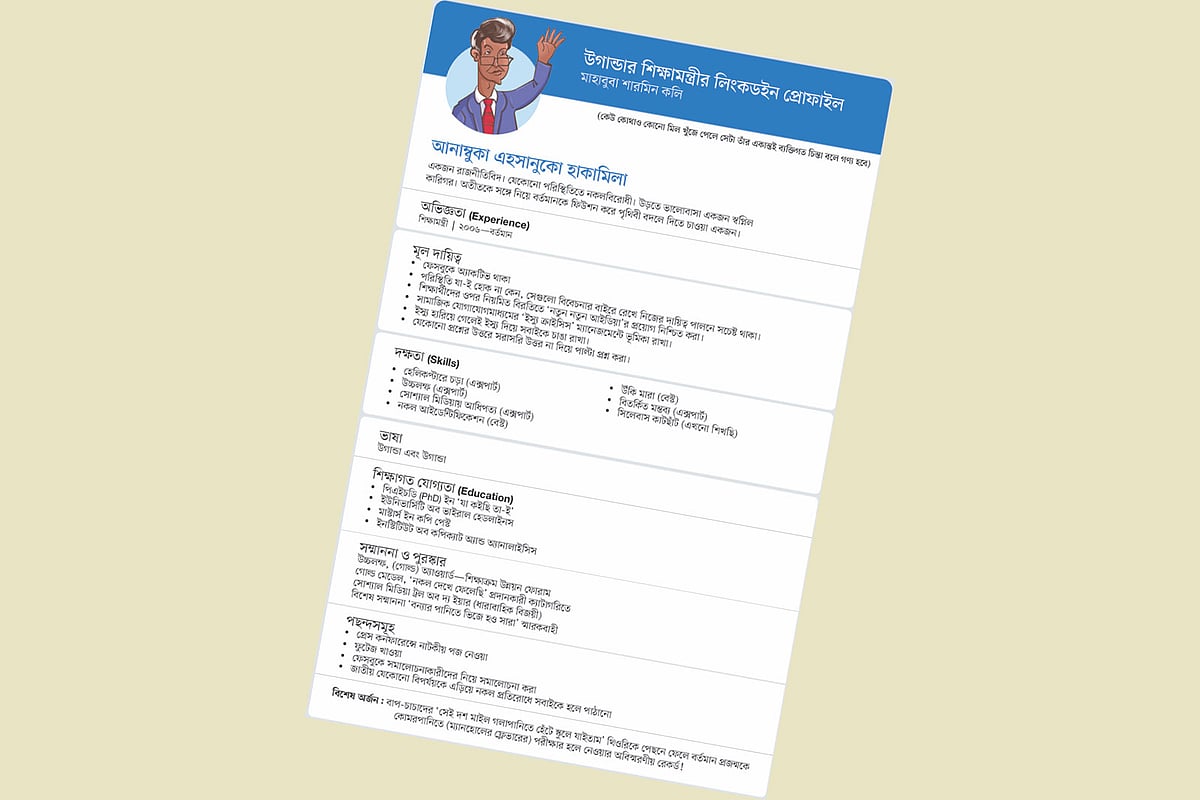
A LinkedIn profile, purportedly belonging to Uganda's Minister of Education, presents a highly unconventional and satirical self-description. The profile lists the individual as a politician and an "anti-counterfeiter in all circumstances," who is a "dreamy craftsman who loves to fly." The experience section, spanning from 2006 to the present, claims the minister's core responsibilities include staying active on Facebook, fulfilling duties regardless of circumstances, ensuring students are regularly exposed to "new ideas," managing social media crises, and reviving issues once they fade. Skills highlighted are "riding helicopters" (expert), "high jump" (expert), "social media dominance" (expert), "counterfeit identification" (best), "peeking" (best), and "controversial remarks" (expert), with "syllabus cutting" listed as "still learning."
Educational qualifications include a PhD in 'Whatever I Said Is True' from the University of Viral Headlines, a Master's in Copy Paste from the Institute of Copycat and Analysis. Awards and honors include a "High Jump (Gold) Award" from the Curriculum Development Forum, a Gold Medal in the 'I Saw the Counterfeit' category, and being a consistent winner of "Social Media Troll of the Year." Special honors include the "Drenched by Floodwaters" memento. Preferences include dramatic poses at press conferences, consuming footage, criticizing critics on Facebook, and urging everyone to attend exams during national disasters to prevent cheating. A special achievement noted is the "unforgettable record" of pushing the current generation into waist-deep (manhole-flavored) examination halls, surpassing the "walked ten miles in floodwaters to school" theory of previous generations.
This satirical LinkedIn profile offers a critique of public figures, particularly those in educational leadership, by exaggerating perceived behaviors and priorities. The profile humorously juxtaposes traditional responsibilities with a focus on social media performance, unconventional skills, and a disregard for substantive educational reform. It highlights potential disconnects between public image and genuine policy impact, suggesting that a focus on trending issues and personal branding may overshadow core duties. The 'analysis' implicitly questions the efficacy of educational governance when skills like 'social media dominance' and 'controversial remarks' are prioritized over pedagogical advancement. This framing encourages reflection on how public discourse and personal presentation can influence perceptions of competence in leadership roles, particularly within the digital age where online presence often dictates public opinion.
AI-generated to prompt reflection — not editorial opinion, not advice, not a statement of fact. How this works.