UK Foreign Secretary Warns of AI Security Threat, Calls for Global Regulation
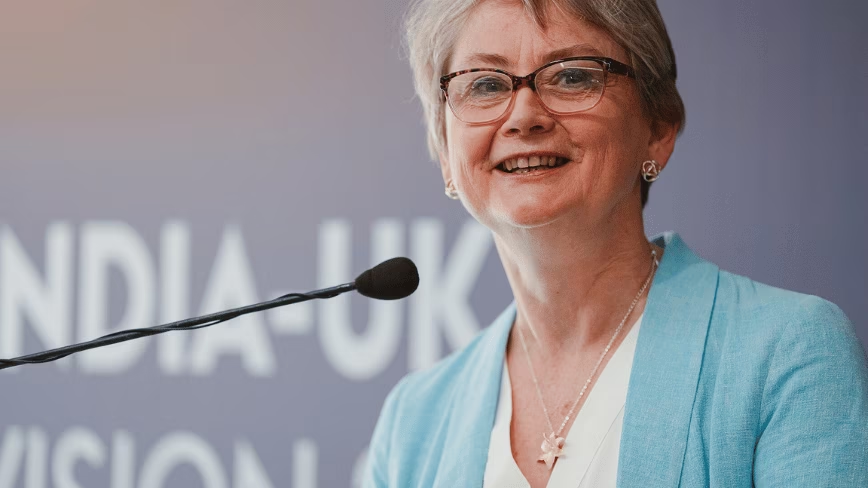
British Foreign Secretary Yvette Cooper has drawn a stark comparison for artificial intelligence, warning that the world should not wait for a "Hiroshima moment" before establishing global rules. She is set to declare that AI could represent the "greatest security challenge of the next decade." Cooper's concerns are detailed in an essay published by the Chatham House think tank. The warning emphasizes the urgent need for international cooperation and regulatory frameworks to address the potential risks associated with advanced AI technologies. The statement highlights a growing apprehension among global leaders regarding the future implications of AI on security and stability. The call for proactive regulation underscores the perceived magnitude of the threat, suggesting that inaction could lead to catastrophic consequences.
AI's rapid advancement presents a complex governance challenge, balancing innovation with potential security risks. The analogy to historical catastrophes, while attention-grabbing, frames the discussion around reactive rather than proactive policy. International bodies face the task of developing adaptable regulatory frameworks that can keep pace with technological evolution without stifling progress. The core issue lies in establishing mechanisms for accountability and control over increasingly autonomous systems. Future policy will need to consider the global nature of AI development and deployment, requiring unprecedented levels of international cooperation to manage risks effectively and ensure equitable benefits.
AI-generated to prompt reflection — not editorial opinion, not advice, not a statement of fact. How this works.