US Imposes 25% Tariffs on Brazil, Sparking Global Media Concern Over Election Impact
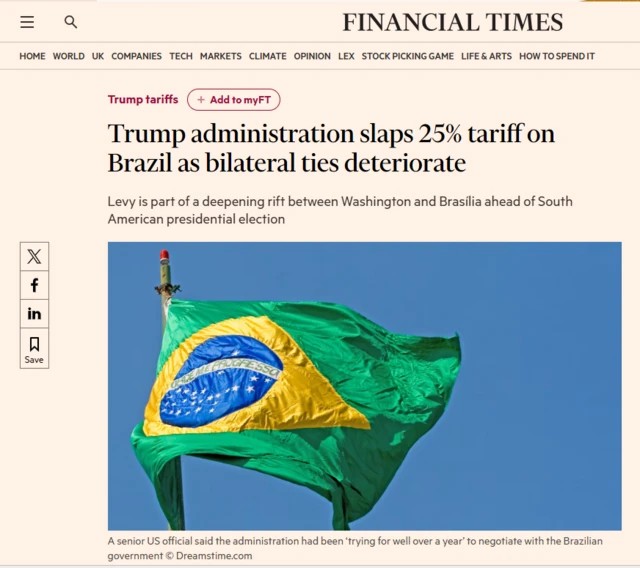
The United States, under the Trump administration, has confirmed a new 25% tariff on Brazilian products, set to take effect on July 22nd. This decision has drawn significant attention from international media, which widely reported on the deteriorating diplomatic relations between the U.S. and Brazil just months before the Brazilian presidential elections. Major publications highlighted the timing of the tariffs, suggesting they could become a central political issue in the upcoming electoral campaign. The "Financial Times" noted the measure deepens bilateral tensions ahead of the South American nation's elections, while the "New York Times" predicted the tariffs would likely become a political talking point before the October presidential vote. "The Guardian" focused on Brazil's response, quoting that "Trump has turned a country's autonomy into a commercial offense," and pointed out the U.S. maintains a trade surplus with Brazil. Spanish newspaper "El País" described the tariffs as a commercial "blow and punishment" occurring on the eve of the election campaign, potentially influencing the race between Lula and Jair Bolsonaro's son, Flávio Bolsonaro. French newspaper "Le Monde" also emphasized that the U.S. tax increase has become a political matter in Brazil, echoing concerns about the legality of the tariffs raised by the Brazilian government.
The imposition of U.S. tariffs on Brazil, particularly in the lead-up to Brazilian elections, highlights the intersection of trade policy and geopolitical strategy. From a U.S. perspective, such actions may be intended to leverage economic pressure for political gain or to address perceived trade imbalances, aligning with a broader strategy to assert influence in Latin America. However, this approach risks exacerbating bilateral tensions and could be perceived internationally as interference in another nation's democratic process. For Brazil, the tariffs present a complex challenge, potentially impacting its economy and becoming a focal point in domestic political discourse. The situation underscores the growing trend of trade disputes being weaponized for political objectives, a dynamic that could shape international relations and economic policies in the coming decade as nations navigate complex global interdependence and domestic political pressures.
AI-generated to prompt reflection — not editorial opinion, not advice, not a statement of fact. How this works.