US Providers Power Over a Third of European Websites, Highlighting Digital Sovereignty Gaps
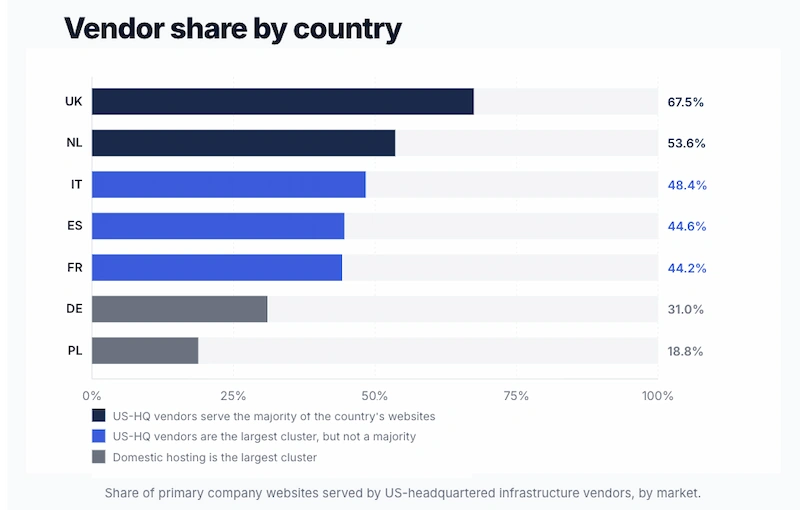
A new analysis by CipherCue reveals that a significant portion of European digital infrastructure relies on U.S.-based providers. The study examined 19,450 European companies across seven markets, focusing on their primary web services through DNS and AS records. Overall, U.S. providers host 7,279 websites, accounting for 37.4% of the total analyzed. Cloudflare emerged as the leading provider across all studied countries, powering 4,490 websites and surpassing any local or regional alternatives. The United Kingdom shows the highest dependence on U.S. hosting at 67.5%, followed by the Netherlands at 53.6% and Italy at 48.4%. Spain relies on U.S. providers for 44.6% of its analyzed entities, while France, Germany, and Poland exhibit lower dependence rates of 18.8%. In Spain, out of 1,427 analyzed entities, 637 use U.S. providers, with Cloudflare powering 329, Amazon 128, and other U.S. firms the remaining 180. This reliance extends beyond physical hosting, as much of the visible web infrastructure is frequently dependent on American companies, raising concerns about digital sovereignty and concentration risks. The findings prompt questions about Europe's pace in achieving digital autonomy.
The CipherCue analysis underscores a substantial dependency of European web infrastructure on U.S. technology firms, raising critical questions about digital sovereignty and the strategic implications of concentrated global service provision. While U.S. providers offer robust and widely adopted services, their dominance highlights a potential vulnerability for European economies and governments, particularly concerning data governance, regulatory oversight, and resilience against external disruptions. The findings suggest a need for Europe to accelerate initiatives aimed at fostering domestic digital capabilities and diversifying its technological supply chain. Future policy considerations may involve incentivizing local cloud infrastructure development, promoting open standards, and strengthening regulatory frameworks to ensure greater control over critical digital assets, balancing the benefits of global interconnectedness with the imperative of strategic autonomy in the digital age.
AI-generated to prompt reflection — not editorial opinion, not advice, not a statement of fact. How this works.