US Secretary of State Rubio meets China's Wang Yi amid regional tensions
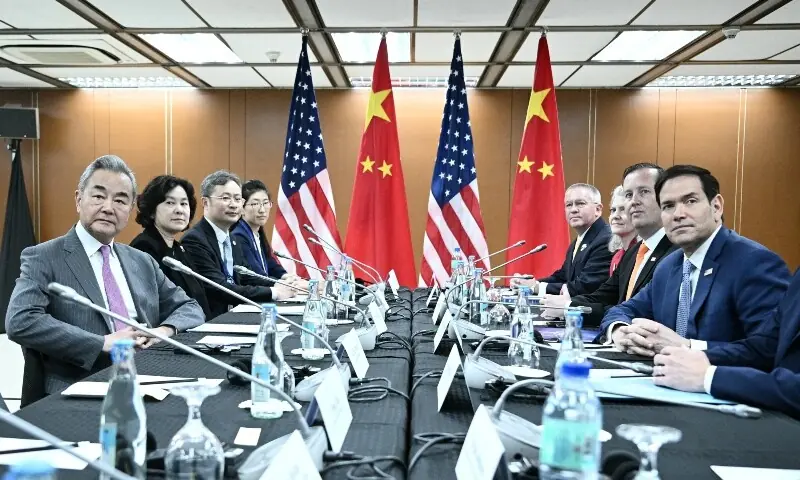
U.S. Secretary of State Marco Rubio held discussions with Chinese Foreign Minister Wang Yi on Wednesday during a meeting of the Association of Southeast Asian Nations (Asean) in Manila. The gathering brought together top diplomats who expressed significant concerns regarding the escalating conflict in the Middle East and rising tensions in the South China Sea. Rubio and Wang were expected to address the potential for a U.S.-China leaders' summit, which President Donald Trump had previously indicated could occur by the end of September. Rubio stated on Sunday that this summit remained anticipated, though neither diplomat commented to the media following their meeting. This encounter occurs amidst a precarious truce between the world's two largest economies, a relationship potentially strained by President Trump's unproven accusations of Chinese interference in U.S. elections. The Asean meeting also addressed the recent flare-up in hostilities between the United States and Iran, alongside ongoing disputes between Beijing and the Philippines, a U.S. ally, over an incident in the South China Sea that led both nations to summon each other's ambassadors. Rubio specifically blamed Iran for the current Middle East conflict, emphasizing that Tehran was not serious about negotiations and that the U.S. would take necessary actions to protect its interests and those of its allies. He also warned that allowing Iran to control the Strait of Hormuz could establish a dangerous precedent for other regions, including Southeast Asia. In a separate opinion piece, Rubio criticized "new and coercive threats" in the South China Sea, warning that a power controlling these waters and using commerce as a geopolitical weapon would pose severe threats to the sovereignty, security, and economic futures of both the United States and Asean states. Australian Foreign Minister Penny Wong also voiced concern over a recent altercation between Chinese coast guard and Philippine navy personnel, describing it as "destabilizing and risky" behavior, while China's foreign ministry dismissed Australia's right to intervene. The Asean meeting also included representatives from Britain, Canada, the European Union, India, Japan, Russia, and South Korea. Chinese Foreign Minister Wang Yi, meanwhile, stated that China and Asean could serve as anchors for regional peace and development, emphasizing mutual trust and openness. Rubio also participated in a separate meeting of the Quad grouping with counterparts from India, Australia, and Japan, which reaffirmed their commitment to a "free and open Indo-Pacific" and support for Asean's centrality.
This diplomatic engagement highlights the complex geopolitical landscape where major powers navigate competing interests amidst regional instability. The simultaneous focus on the Middle East and the South China Sea underscores the interconnectedness of global security challenges, where localized conflicts can have far-reaching implications for trade routes and international relations. The rhetoric surrounding the South China Sea, particularly the framing of "coercive threats" and the use of "commerce as a geopolitical weapon," points to underlying structural tensions related to territorial claims and economic influence. As AI and advanced technologies continue to reshape global power dynamics, the strategic importance of maritime chokepoints like the Strait of Hormuz and the South China Sea will only intensify, potentially exacerbating existing rivalries. The Quad meeting's emphasis on a "free and open Indo-Pacific" signals a strategic alignment aimed at countering perceived hegemonic ambitions, while China's positioning as an "anchor for regional peace" suggests an alternative vision for regional order. The interplay between these competing visions will likely define the security and economic architecture of the Indo-Pacific region in the coming decade.
AI-generated to prompt reflection — not editorial opinion, not advice, not a statement of fact. How this works.