US Tariffs Pressure Sectors, But Brazil Faces Them Less Reliant on US Market
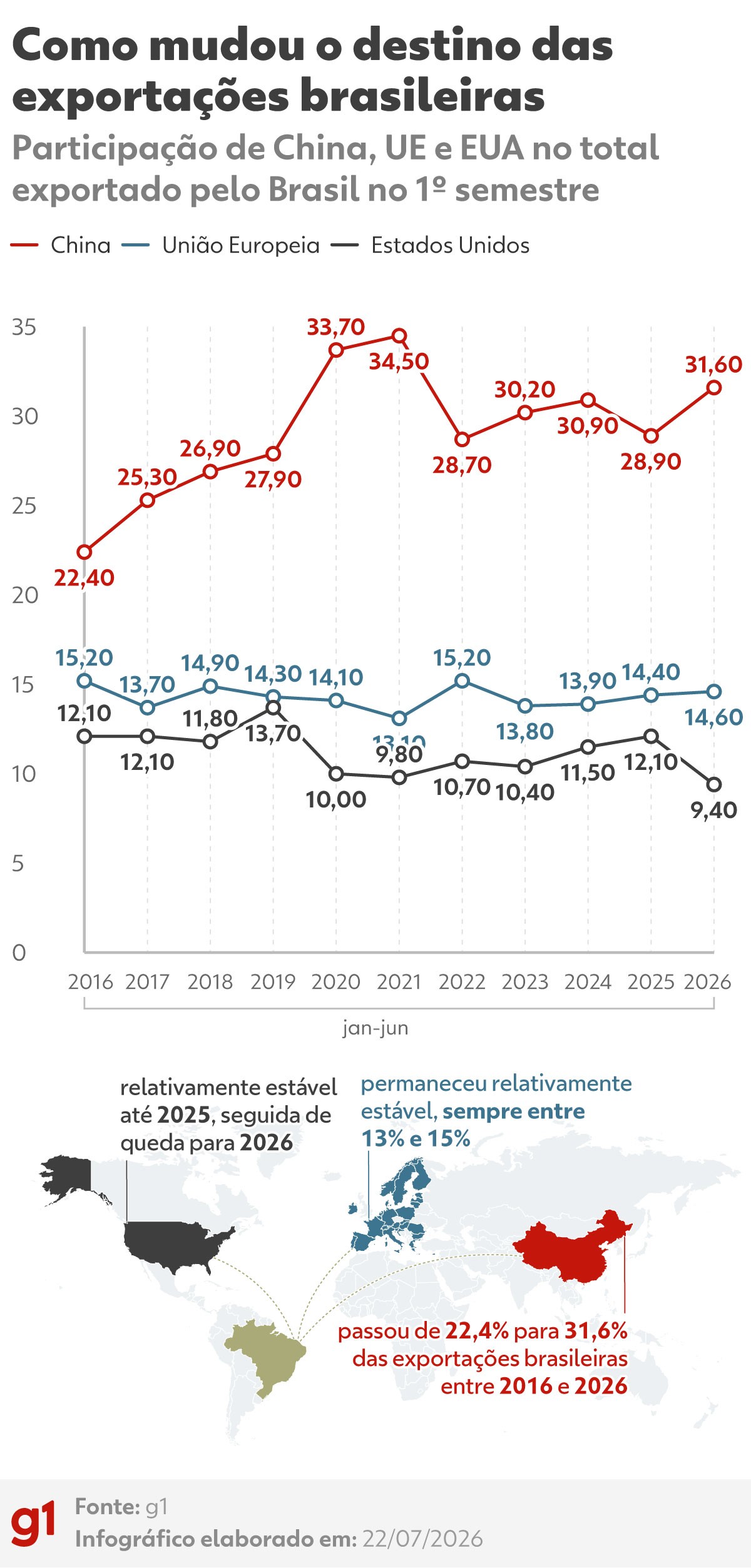
The United States has implemented additional tariffs of 25% on a portion of Brazilian exports, effective Wednesday, August 22nd. While economists do not anticipate a nationwide economic crisis for Brazil, these measures are expected to pressure companies heavily dependent on the U.S. market, potentially causing short-term difficulties in finding new buyers. However, Brazil's trade relationship with the U.S. has shifted significantly over the past two decades. In 2005, the U.S. accounted for approximately 19% of Brazil's total exports; by 2025, this share had fallen to about 12%, and in the first half of 2026, it was down to 9.4%. Concurrently, China has solidified its position as Brazil's primary export destination, now representing over 30% of sales. Experts like Leonardo Paz from FGV and Marcos Crivelaro from Fundação Vanzolini note that Brazil's export base is more diversified, with growing presence in Asian and other emerging markets, largely driven by China's demand for commodities. While 57% of Brazilian exports to the U.S. are unaffected by the new tariffs, and 74% of the 2,400 directly impacted companies already export elsewhere, the challenge lies in finding suitable replacements without creating new dependencies. Commodities are easier to redirect than manufactured goods like footwear, which are often tailored to specific market demands. The process of entering new markets, involving regulatory approvals, logistics, and supply chain development, can take 12 to 36 months. Potential new markets identified include India, Southeast Asian nations, the Middle East, and African economies like Angola and South Africa. Despite the tariffs, Brazilian exports reached a record $348.7 billion in 2025, with significant growth in sales to India, Canada, China, the EU, and Argentina. However, Roberto Dumas of Insper cautions against replacing U.S. dependence with Chinese dependence, advocating for a balanced approach. Fabrizio Panzini of Amcham Brasil highlights that the composition of exports differs significantly, with industrial products dominating sales to the U.S. and commodities to other markets, making direct substitution difficult. Ultimately, experts emphasize that Brazil's ability to navigate these external pressures hinges more on addressing internal competitiveness issues, such as simplifying the tax system, reducing bureaucracy, improving infrastructure, and investing in innovation and education, rather than solely relying on external market diversification.
The imposition of U.S. tariffs on Brazilian exports, while impacting specific sectors, occurs within a context of Brazil's reduced reliance on the U.S. as a primary trading partner. The shift in trade dynamics, with China assuming a dominant role, presents both opportunities and risks of new dependencies. The analysis suggests that Brazil's long-term export strategy should focus on enhancing domestic competitiveness through structural reforms rather than solely on geographical diversification. Factors such as innovation, productivity, logistical infrastructure, and a simplified regulatory environment are identified as critical for sustained growth and resilience in an evolving global trade landscape. The challenge lies in managing the transition for affected industries while fostering a more robust and diversified economic base that can withstand external shocks.
AI-generated to prompt reflection — not editorial opinion, not advice, not a statement of fact. How this works.