War Atlas: Interactive Map Visualizes 10,584 Wars Across 4,500 Years
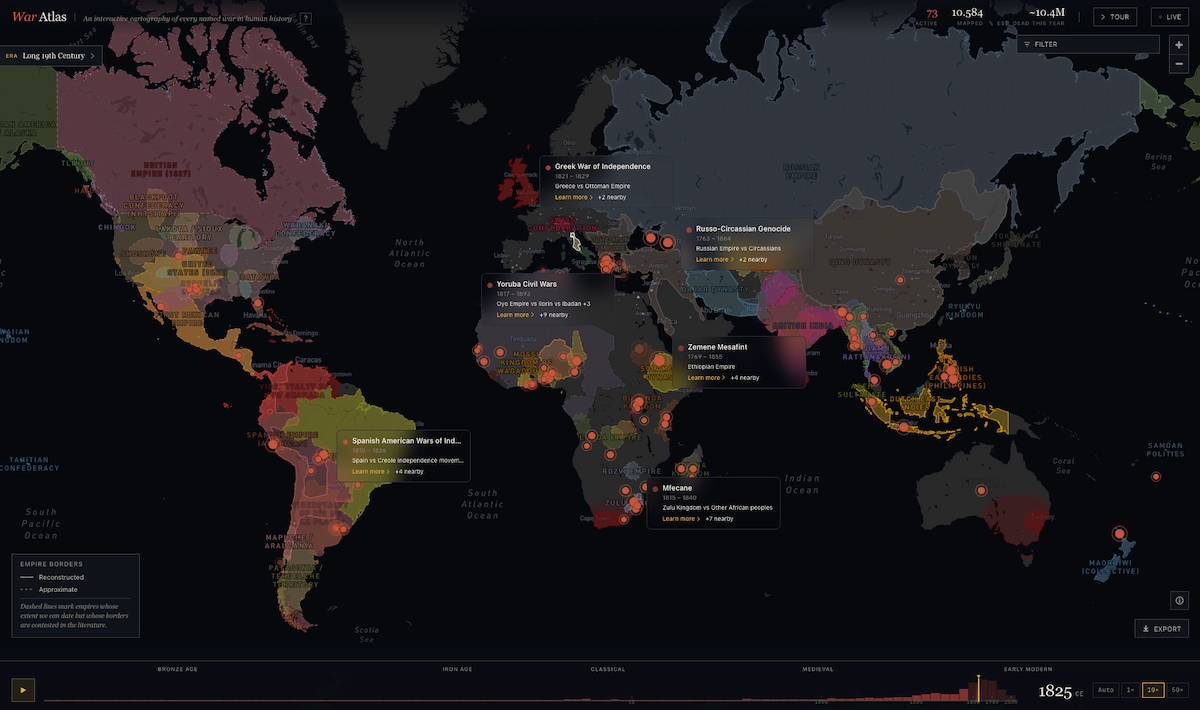
An interactive infographic named War Atlas meticulously documents 10,584 wars spanning 4,500 years of human history. The project, conceptualized by friends in 2009 and launched in a beta version in May 2026, traces armed conflicts from 3,100 BCE, starting with the reunification of Egypt, up to the present day. It visually represents the evolution of warfare, from Bronze Age weaponry to atomic-era technology, encompassing conflicts of varying scales and impacts. The database incorporates 10,584 distinct wars and categorizes 427 "political entities," including empires, kingdoms, and republics. Additionally, it features approximately 700 historical city names that dynamically change to reflect shifts in political control, often renamed by victorious factions. War Atlas allows users to observe the rise and fall of conflicts and the transformation of political borders over time. The information is primarily sourced from Wikipedia, supplemented by specialized historical works, atlases, and contemporary geographic data. Key interactive features include a timeline from the Bronze Age to the present, synchronized war and border displays, historical city name changes, and estimated victim counts for around 150 major conflicts where historical consensus varies. Users can navigate through centuries or decades via keyboard shortcuts and utilize an automated historical evolution playback. Despite its comprehensive scope, the atlas has limitations, particularly for conflicts predating 1500 and those outside Europe, with some ancient borders and casualty figures for ongoing wars noted as approximate. The creators anticipate future improvements with volunteer contributions.
The War Atlas project offers a valuable, data-driven perspective on the pervasive nature of human conflict throughout history. By visualizing over 10,000 wars across millennia, it challenges simplistic narratives and highlights the cyclical patterns of geopolitical instability. The project's reliance on Wikipedia and historical sources, while comprehensive, underscores the inherent challenges in historical data accuracy, particularly concerning casualty figures and precise border definitions for ancient periods. Future iterations could benefit from integrating diverse academic methodologies to refine these estimates. The tool's design prompts reflection on the persistent human tendency towards organized violence, urging a deeper understanding of its root causes and systemic drivers, rather than mere chronological cataloging. This objective mapping of conflict evolution serves as a critical resource for historical analysis and a sober reminder of humanity's ongoing struggle to achieve lasting peace.
AI-generated to prompt reflection — not editorial opinion, not advice, not a statement of fact. How this works.