Webb Telescope Investigates Origins of Mysterious Distant Red Objects
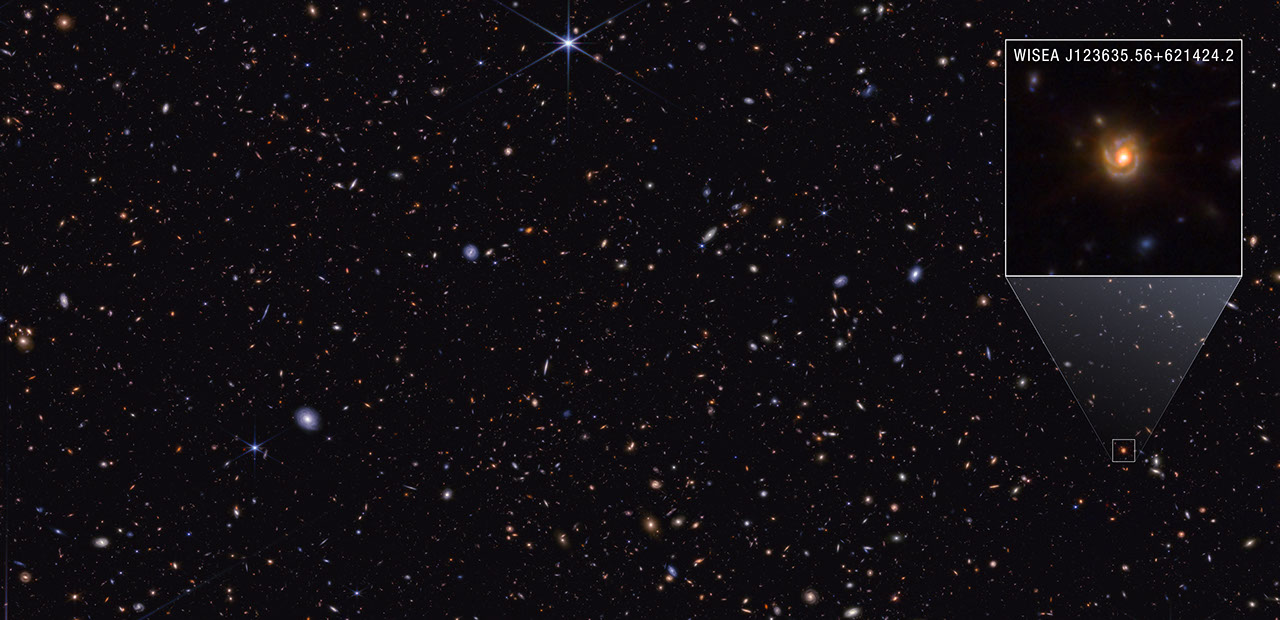
Astronomers are actively studying mysterious 'little red dots' (LRDs) that were first detected by NASA's James Webb Space Telescope in 2022. These extremely distant and compact red sources have presented a significant puzzle for the scientific community. A leading hypothesis suggests that these LRDs could be active supermassive black holes. The ongoing research aims to unravel the nature and formation of these enigmatic celestial objects. Understanding their characteristics is crucial for comprehending the early universe and the evolution of galaxies. The Webb Telescope's advanced capabilities are instrumental in capturing the faint light from these far-off phenomena. Further observations are planned to gather more data and refine existing theories. The discovery of LRDs highlights the ongoing potential for unexpected findings with powerful new astronomical instruments. Scientists are eager to determine if these objects represent a new class of celestial bodies or are related to known phenomena in an unexpected way. This exploration is a testament to the continuous quest for knowledge about the cosmos.
The discovery of 'little red dots' by the James Webb Space Telescope presents an opportunity to refine our understanding of early cosmic structures. Investigating these distant, compact red sources, potentially active supermassive black holes, allows for empirical testing of models concerning galaxy formation and black hole growth in the universe's infancy. This scientific endeavor underscores the value of advanced observational tools in pushing the boundaries of astrophysics. Future research will likely focus on spectroscopic analysis to confirm composition and activity levels, thereby clarifying whether these LRDs represent a known phenomenon viewed in a new light or an entirely novel class of astronomical object. Such discoveries are critical for building a more complete picture of cosmic evolution over the next decade and beyond.
AI-generated to prompt reflection — not editorial opinion, not advice, not a statement of fact. How this works.