Webb Telescope Uses Gravitational Lensing to Study Early Galaxies
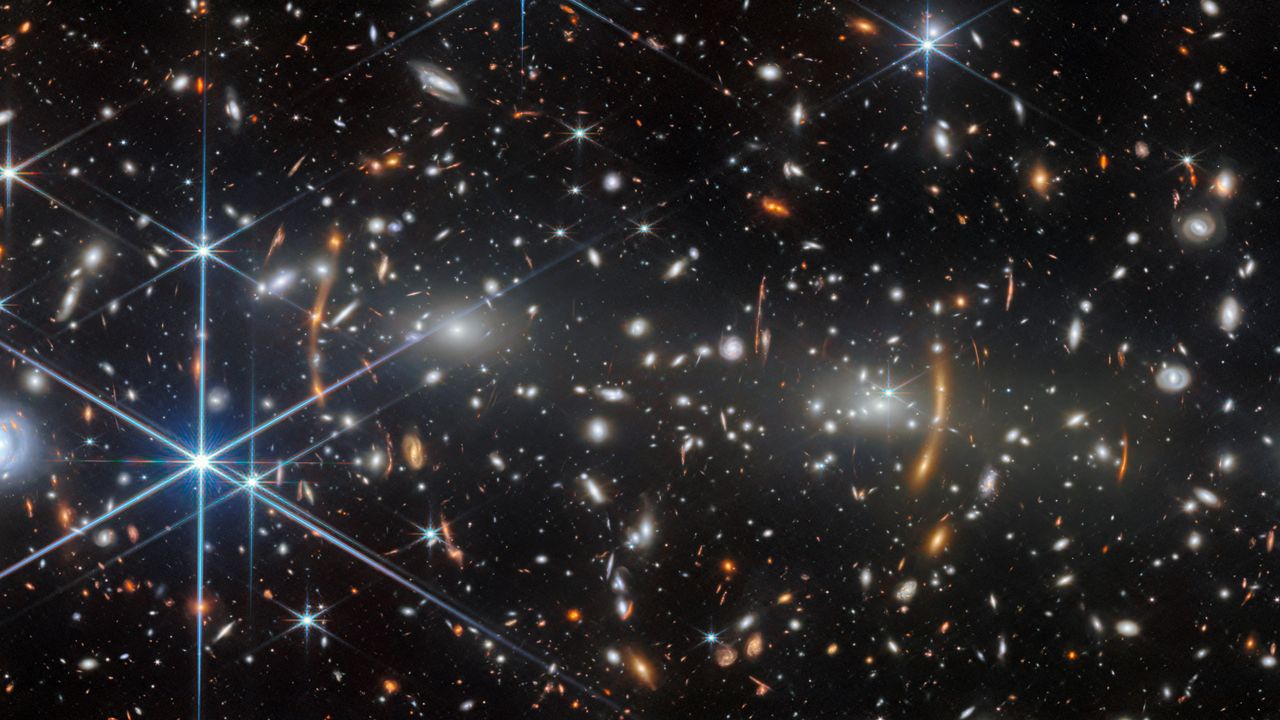
The James Webb Space Telescope is employing a phenomenon predicted by Albert Einstein to observe galaxies that existed within the first billion years after the Big Bang. This technique involves utilizing gravitational lensing, where the massive gravity of foreground objects warps the fabric of space-time. This warping acts like a cosmic magnifying glass, bending and amplifying the light from more distant, fainter galaxies. By studying these ancient galaxies, scientists aim to understand the conditions and processes that shaped the early universe. The telescope's advanced infrared capabilities are crucial for detecting the faint, redshifted light from these extremely distant objects. This observation strategy allows astronomers to probe regions of the universe that would otherwise be beyond our current observational limits. The data gathered will provide unprecedented insights into galaxy formation and evolution in the universe's infancy. This method highlights the synergy between theoretical physics and cutting-edge astronomical instrumentation.
The James Webb Space Telescope's application of gravitational lensing exemplifies how advanced scientific instruments can operationalize complex theoretical predictions. This technique allows for the observation of cosmic phenomena that are otherwise undetectable, pushing the boundaries of our understanding of the early universe. By leveraging the gravitational influence of massive foreground objects, astronomers can effectively amplify the light from distant galaxies, providing a unique window into cosmic history. This approach underscores the importance of fundamental physics in driving technological innovation and scientific discovery. Future advancements may involve more sophisticated algorithms to further refine these observations and extract deeper insights into the universe's formation and evolution.
AI-generated to prompt reflection — not editorial opinion, not advice, not a statement of fact. How this works.