World's Largest Digital Camera Begins Decade-Long Sky Survey at Vera C. Rubin Observatory
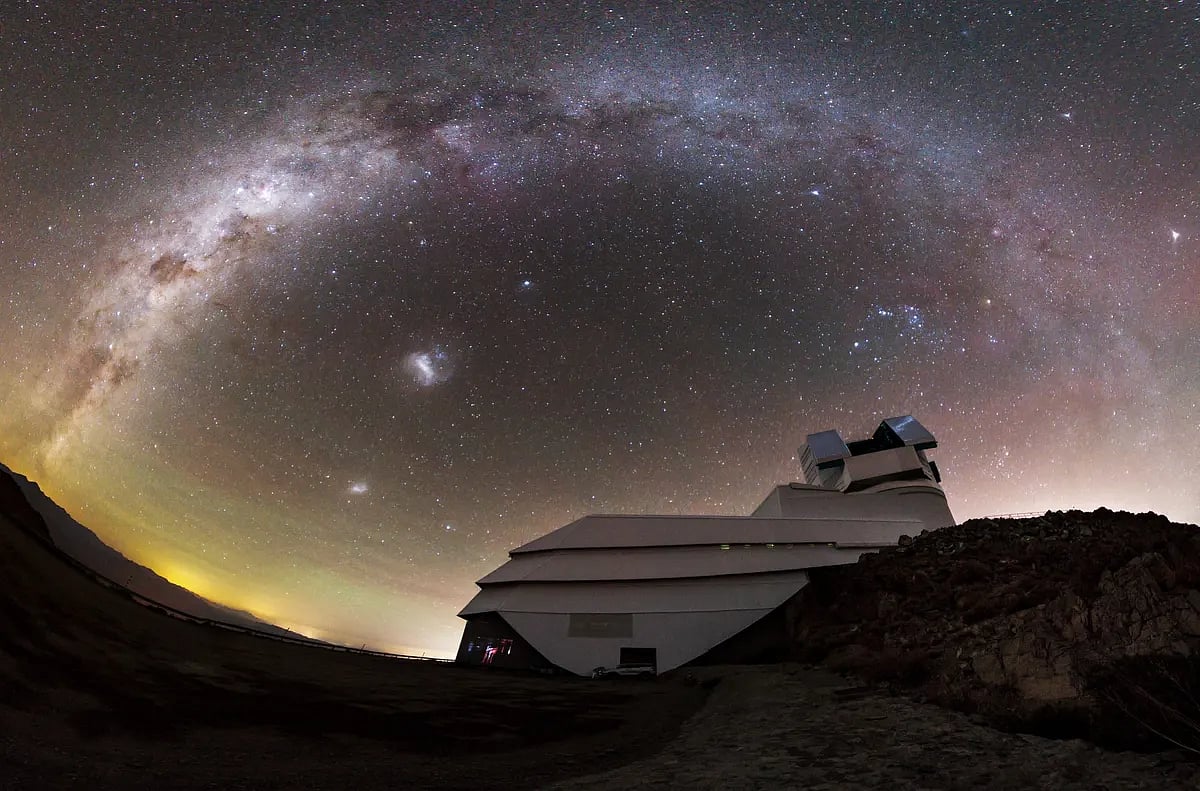
The Vera C. Rubin Observatory in Chile has commenced a groundbreaking 10-year project named the Legacy Survey of Space and Time (LSST), effectively creating a decade-long "movie" of the universe. This ambitious survey aims to capture an unprecedentedly detailed and extensive map of the visible night sky, a feat previously impossible in astronomical research. The observatory's unique design allows it to observe half of the entire sky with exceptional sensitivity and repeated observations over a continuous decade.
At the heart of this endeavor is the world's largest digital camera, boasting a staggering 3,200-megapixel resolution. This colossal camera weighs 3,000 kilograms and its lens is so large that a single exposure captures an area equivalent to 45 full moons side-by-side in the sky. Its precision is such that it can clearly photograph a golf ball from 25 kilometers away. The data generated is immense; viewing a single full-resolution image would require a grid of 378 4K Ultra-HD televisions.
The LSST is expected to detect and analyze approximately 40 billion celestial objects, vastly exceeding humanity's current population. This technological leap is poised to revolutionize astronomy, with automated notifications alerting scientists to unusual celestial events, including potential interstellar objects from other solar systems. The project's advanced mount allows the telescope to reposition itself within five seconds with minimal vibration, crucial for rapid sky scanning.
The Vera C. Rubin Observatory's LSST project represents a significant advancement in observational astronomy, leveraging immense computational and imaging power to create a comprehensive, dynamic map of the cosmos. By integrating advanced optics and an unprecedentedly large digital sensor, the observatory aims to democratize astronomical data, enabling the detection of billions of objects and potentially thousands of new phenomena, including interstellar visitors. This initiative highlights a trend towards large-scale, long-duration sky surveys, which are essential for understanding cosmic evolution, dark energy, and the transient nature of celestial events. The project's success hinges on robust data management and analysis infrastructure, capable of processing petabytes of information, and its findings will likely shape astrophysical research for decades to come, offering new perspectives on the universe's ongoing transformation.
AI-generated to prompt reflection — not editorial opinion, not advice, not a statement of fact. How this works.