Xi Jinping Positions China as Global AI Leader, Challenging US Influence
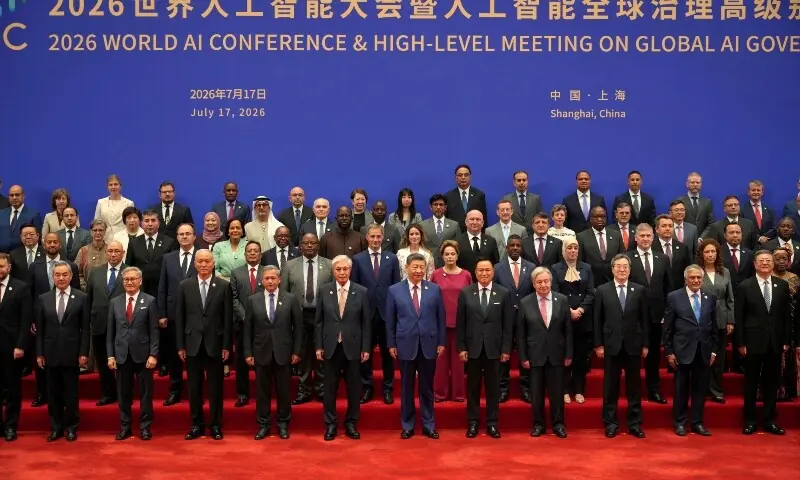
Chinese President Xi Jinping has declared Beijing's ambition to lead a new global artificial intelligence (AI) order, aiming to counter US dominance in the rapidly evolving sector. Speaking at the World Artificial Intelligence Conference (WAIC) in Shanghai, Xi promoted open-source AI technology as a historic opportunity and pledged support for developing nations to build their AI capabilities. He warned against the creation of "new historical injustices" due to unequal access to AI, framing China's approach as a global public good and an alternative to Washington's influence. Xi likened AI's importance to the steam engine and electricity, envisioning China sharing its AI expertise with the Global South and leading the establishment of international standards. This initiative positions China's AI coalition as a rival to the US-led "Pax Silica" initiative, which focuses on securing AI and critical mineral supply chains. The speech coincided with rapid advancements in Chinese open-weight AI models, such as Moonshot AI's Kimi K3, which reportedly has the world's largest parameter count. Xi also emphasized the need for human control over AI systems, urging the establishment of early-warning mechanisms and emergency responses to manage AI risks and prevent autonomous systems from evading human oversight. The formation of the China-created World AI Cooperation Organisation (WAICO), with 29 founding member countries including Pakistan, was highlighted as a significant milestone for global AI development and governance, particularly for the Global South. China plans to expand AI training and cooperation centers with major blocs like BRICS, ASEAN, and the African Union, aligning its AI diplomacy with its existing influence in these regions. The WAIC serves as a platform for China to assert its leadership in AI technology and standards, potentially setting the stage for future competition over global AI governance rules.
President Xi Jinping's address at the WAIC signals China's strategic intent to reshape global AI governance, leveraging open-source models as a means to democratize access and challenge existing technological hierarchies. By framing AI development as a global public good and offering capacity-building to developing nations, Beijing aims to cultivate international partnerships and establish norms that may diverge from those promoted by the US and its allies. This approach could foster a bifurcated global AI ecosystem, with differing standards and governance frameworks. The emphasis on human control and risk management, while ostensibly addressing safety concerns, also serves to assert national sovereignty over AI development and deployment. China's initiative presents a complex geopolitical dynamic, where technological leadership is intertwined with the pursuit of economic influence and the redefinition of international order in the AI era.
AI-generated to prompt reflection — not editorial opinion, not advice, not a statement of fact. How this works.