Xiangdao Mobility Pursues Second IPO Amid Driver Shortages and Platform Dependence
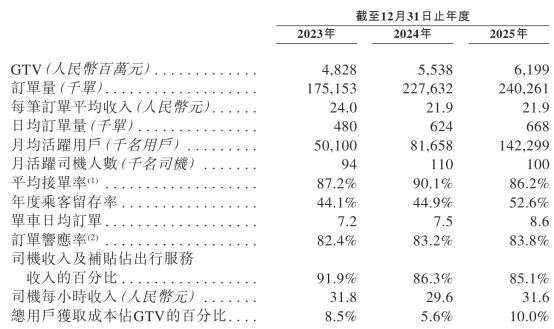
Xiangdao Mobility, backed by SAIC Group, has refiled for its second IPO in Hong Kong, aiming to showcase improving profitability. The company's revenue grew from 5.718 billion yuan in 2023 to 6.774 billion yuan in 2025, while net losses narrowed significantly from 604 million yuan to 246 million yuan. Gross profit margins also saw a substantial increase, rising from 6.6% to 11.0% over the same period. This financial improvement is attributed to scale effects, with Gross Transaction Value (GTV) and order volume increasing by approximately 10% annually between 2024 and 2025.
However, Xiangdao faces a "scissors gap" in its operational data. Despite financial growth, the number of active drivers has seen minimal expansion, with only a slight increase from 94,000 in 2023 to 100,000 in 2025. Notably, active drivers decreased by 9% from 2024 to 2025. This indicates that revenue growth is driven by increased order volume per vehicle rather than driver expansion, as the average order revenue per driver remained stable at 21.9 yuan in 2024 and 2025.
The company's growth is heavily reliant on external aggregation platforms, with 98.5% of orders and GTV originating from platforms like Gaode, Didi, and Meituan. In 2025, Xiangdao paid 556 million yuan in commissions to these platforms, an increase of 114 million yuan. While this generated 661 million yuan in incremental GTV, it significantly compressed profit margins, with 85% of new GTV going to driver commissions and subsidies. Xiangdao's ability to compete on price is limited, especially against giants like Didi.
Looking ahead, Xiangdao is exploring Robotaxi as a second growth curve, planning to collaborate with SAIC and Momenta. Xiangdao will focus on its intelligent dispatch and safety monitoring systems, while partners lead autonomous driving technology and vehicle development. However, the transition to Robotaxi challenges the traditional value of ride-hailing platforms, which relied on driver management. The company is also cautiously approaching international expansion, which may impact its valuation. Xiangdao's investor base includes Momenta for autonomous driving, Gaode for traffic data and user access, and CATL for battery solutions, though the synergy of these partnerships in a cost-sensitive market remains to be seen.
Xiangdao Mobility's IPO pursuit highlights a common challenge in the ride-hailing sector: balancing growth with profitability amid intense competition and platform dependency. The company's reliance on third-party aggregators for a vast majority of its orders, while generating incremental GTV, significantly erodes profit margins due to commission fees. This dynamic suggests an ongoing struggle for pricing power and a potential "rent-seeking" relationship where platform providers capture most of the value. The company's strategic pivot towards Robotaxi, while forward-looking, faces substantial capital requirements and a fundamental shift in the industry's value proposition, moving away from driver management towards technology and data infrastructure. The effectiveness of its partnership model, particularly with entities like Gaode and CATL, will depend on whether cost efficiencies can be achieved without compromising service competitiveness, a significant hurdle in a market driven by price sensitivity and operational leverage.
AI-generated to prompt reflection — not editorial opinion, not advice, not a statement of fact. How this works.