Yemen's Government Strikes Houthi-Controlled Sanaa Airport, Raising Fears of Renewed Conflict
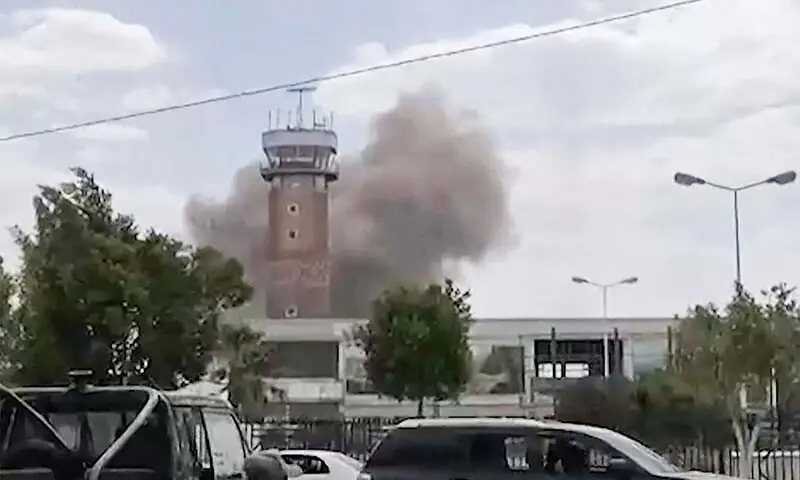
Yemen's internationally recognized government announced it conducted airstrikes on the Houthi-controlled Sanaa airport on Monday, marking a significant escalation in the dormant conflict. The government stated its objective was to prevent an Iranian plane from landing, after failing to persuade a Houthi delegation returning from Iran to use a commercial flight instead. The Houthi military spokesman, Yahya Saree, accused Saudi Arabia of initiating the attack and vowed retaliation, declaring the "de-escalation phase" over. This incident jeopardizes the fragile truce that has been in place since April 2022, amid broader regional tensions involving the United States and Iran. Yemen's defense ministry asserted that the Houthis allowed an Iranian plane to violate Yemeni territory, leading to the targeting of the airport runway. Rashad al-Alimi, head of Yemen’s Presidential Leadership Council, has ordered that the confrontation not be expanded. Analysts warn that a continued cycle of action and retaliation could lead to the collapse of the ceasefire and a return to intense fighting. The government also briefly ordered all airports nationwide closed. Tensions had been escalating, with the Houthis previously accusing Saudi Arabia of attacking an Iranian plane and threatening strikes on Saudi targets. The United Nations Special Envoy for Yemen, Hans Grundberg, has urged diplomatic engagement, and the International Committee of the Red Cross confirmed its staff and crew were safe after an incident where a government spokesperson accused the Houthis of preventing an ICRC aircraft from departing Sanaa.
This escalation at Sanaa airport highlights the persistent fragility of the Yemeni conflict and the complex geopolitical dynamics at play. The government's action, framed as a response to an Iranian aircraft, suggests a strategic attempt to reassert control over sovereign airspace and challenge Houthi influence, potentially leveraging regional tensions. The Houthi response, immediately blaming Saudi Arabia and threatening retaliation, demonstrates their capacity to frame the conflict and mobilize support through accusations of aggression. This incident underscores the precariousness of the 2022 truce, indicating that underlying systemic issues and external influences continue to undermine peace efforts. The international community faces the challenge of de-escalating tensions without exacerbating proxy conflicts, necessitating a renewed focus on inclusive diplomatic solutions that address the root causes of the ongoing humanitarian crisis.
AI-generated to prompt reflection — not editorial opinion, not advice, not a statement of fact. How this works.