Zeno's Dichotomy Paradox: The Illusion of Motion and How to Escape It
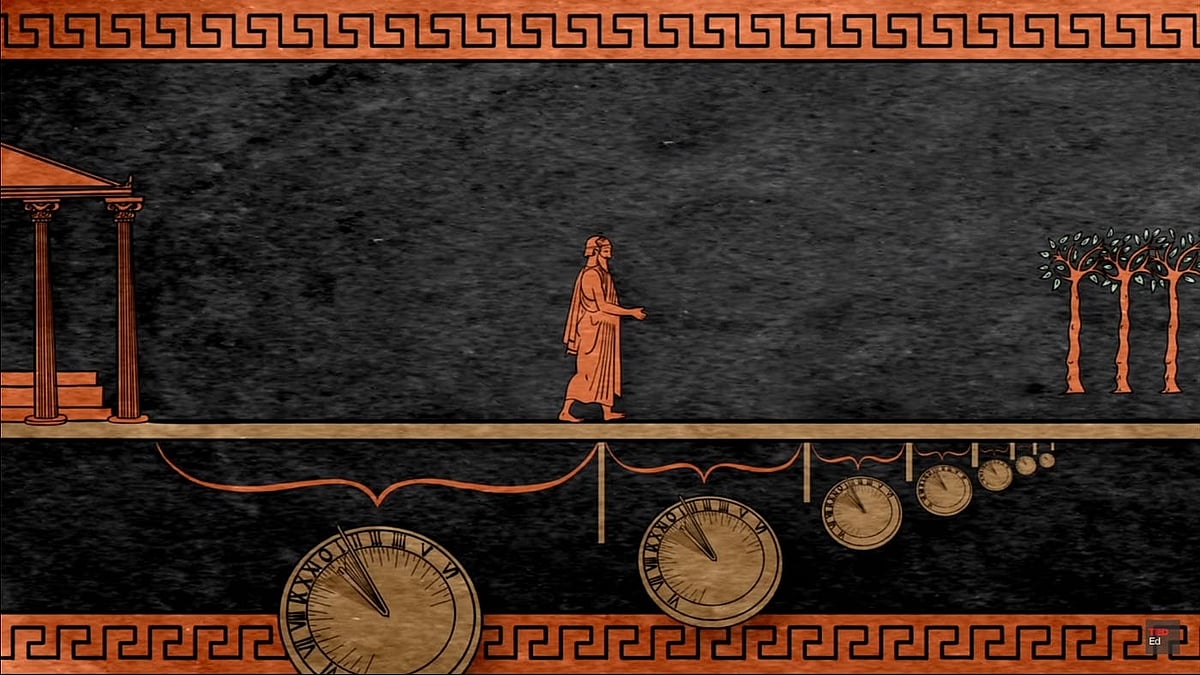
The article explores Zeno's Dichotomy paradox, which argues that motion is an illusion. The paradox posits that to travel any distance, one must first cover half the distance, then half of the remaining distance, and so on. This process, if continued infinitely, suggests that one can never even take the first step, implying that movement is impossible. The author likens this to an unsolvable maze where reaching a destination requires traversing an infinite number of steps.
Ancient Greek philosophers grappled with Zeno's paradoxes. While Aristotle acknowledged the logical construction of Zeno's arguments, which used a method called 'reductio ad absurdum' to highlight absurdity, he recognized that motion is observable. The article highlights the Cynic philosopher Diogenes, who famously refuted Zeno's theory of motion being an illusion not through philosophical debate, but by simply standing up and walking away. This act, though effective in demonstrating the absurdity of Zeno's logic, is deemed insufficient from a physics perspective.
From a scientific standpoint, the paradox arises from misinterpreting the relationship between distance and time. Speed is defined as distance covered over a specific time. When a distance is divided into smaller halves, the time required to cover each segment also halves. Time, however, is continuous and does not stop, allowing for forward progress. Newton's laws of motion also explain that an object at rest requires a force to initiate movement, after which it continues to move. While modern physics, like Einstein's theory of relativity, suggests time can be considered a dimension and its flow might be an illusion under certain conditions (near light speed), these complexities are not necessary to resolve Zeno's everyday paradox. At the quantum level, space and time behave differently, making infinite division impossible. Ultimately, Zeno's paradox is presented as an abstract logical puzzle rather than a reflection of physical reality.
Zeno's Dichotomy paradox, while a compelling thought experiment, highlights a fundamental disconnect between abstract mathematical division and the continuous nature of physical reality. The paradox arises from treating space and time as infinitely divisible without accounting for the continuous flow of time and the principles of motion. From a systems perspective, the paradox fails to incorporate the concept of limits and convergence, where an infinite series can sum to a finite value, a concept later formalized in calculus. While modern physics, particularly relativity and quantum mechanics, offers deeper insights into the nature of space-time, these advanced theories are not required to understand why Zeno's logic, when applied to everyday experience, leads to an absurd conclusion. The paradox serves as a valuable lesson in distinguishing between theoretical constructs and empirical observation, urging us to consider the practical implications and underlying assumptions of any logical framework.
AI-generated to prompt reflection — not editorial opinion, not advice, not a statement of fact. How this works.