Zeno's Paradoxes: How Ancient Greek Logic Challenged the Nature of Motion
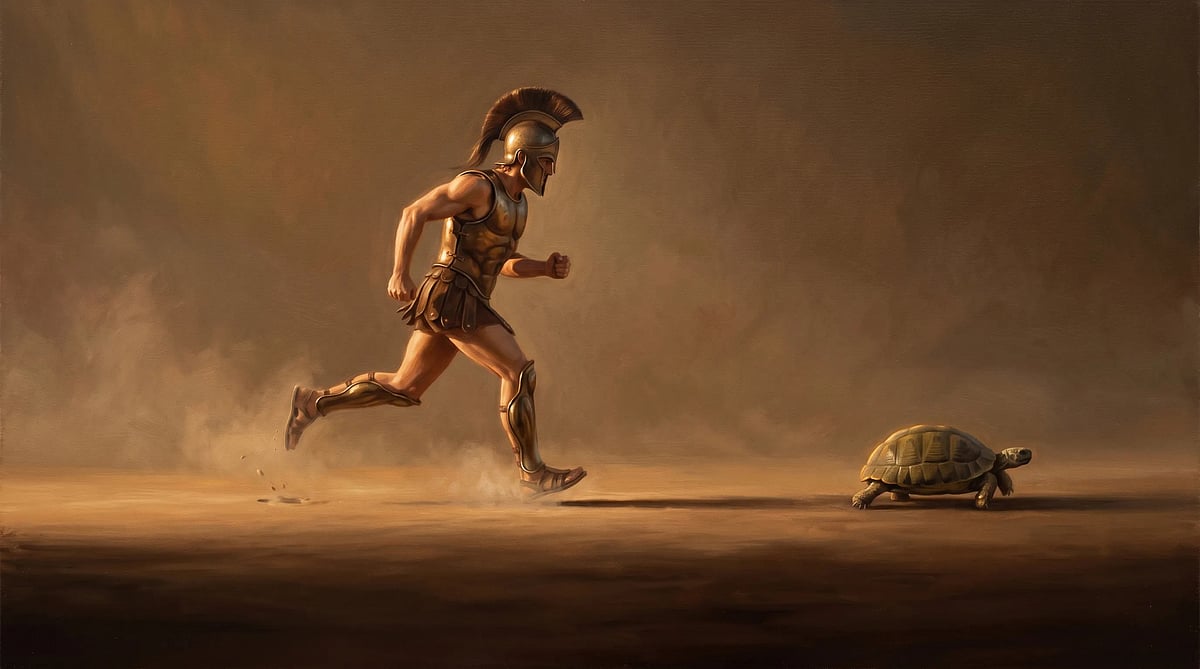
The article delves into the philosophical paradoxes presented by the ancient Greek philosopher Zeno of Elea, who lived approximately 2,500 years ago. Zeno, a student of Parmenides and a proponent of the Eleatic school of thought, argued that motion is an illusion and that reality should be understood through logic rather than sensory perception. He is credited with developing around 40 paradoxes, with four famous ones surviving: Achilles, Dichotomy, Stadium, and Arrow. These paradoxes fundamentally question the existence of motion and time, suggesting they are merely mental constructs.
Zeno's most celebrated paradox, 'Achilles and the Tortoise,' illustrates this concept. It posits that the swift hero Achilles can never overtake a slower tortoise if the tortoise is given a head start. Zeno reasoned that Achilles must first reach the tortoise's starting point, by which time the tortoise will have moved slightly forward. This process repeats infinitely, with Achilles always needing to cover a progressively smaller, yet still existing, distance to reach the tortoise's previous position. Consequently, Zeno concluded, Achilles could never catch up.
The article explains that Zeno's logical error stemmed from a lack of understanding of infinite series and fundamental physics principles like the relationship between distance, speed, and time. While Zeno believed that an infinite number of steps would require an infinite amount of time, modern mathematics and physics demonstrate that an infinite series can converge to a finite sum and time. For instance, the sum of 1 + 1/2 + 1/4 + 1/8... approaches 2, not infinity. Applied to the Achilles paradox, the decreasing time intervals and distances sum to a finite amount, allowing Achilles to catch the tortoise within a specific, calculable time, provided he maintains a constant speed.
Zeno of Elea's paradoxes, though ancient, highlight enduring challenges in reconciling mathematical abstractions with physical reality. His arguments compel us to examine the assumptions underlying our understanding of continuity, infinity, and motion. While modern calculus and physics provide mathematical resolutions, the paradoxes serve as a valuable thought experiment, prompting critical thinking about the discrete versus continuous nature of space and time. In the context of an increasingly digitized and simulated world, Zeno's questions about the nature of perceived reality and the limitations of logical models remain relevant, encouraging a deeper appreciation for the interplay between abstract reasoning and empirical observation in scientific advancement.
AI-generated to prompt reflection — not editorial opinion, not advice, not a statement of fact. How this works.