Zillow's AI Strategy: Context Over Data, Custom Architecture for Customer Journey
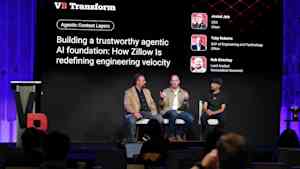
At the VB Transform 2026 conference, Zillow's SVP of Engineering, Toby Roberts, and Glean co-founder and CEO, Arvind Jain, discussed the real estate technology company's approach to artificial intelligence. Zillow, which impacts approximately 80% of U.S. real estate transactions annually, has been an early adopter of AI. Roberts emphasized that the core challenge in their AI development was not data acquisition, but rather building a persistent context layer to maintain continuity for customers and professionals throughout their lengthy and complex real estate journeys. This context layer is crucial because customer interactions often span multiple platforms and involve various professionals, from loan officers to agents, over extended periods.
Instead of relying on a single chatbot or external API, Zillow developed its own AI architecture. This custom solution leverages two decades of machine learning expertise, favoring smaller, task-specific fine-tuned models over a single, large general-purpose model. This internal architecture works in conjunction with Glean, which provides thousands of agents handling repetitive tasks across Zillow. Glean's platform aims to centralize integration work, preventing redundant efforts by different departments like finance, legal, and marketing. Jain highlighted that Glean offers cost-saving mechanisms through intelligent model routing to smaller, less expensive models and precomputed context, significantly reducing token consumption compared to models that assemble context from scratch.
The session offered key takeaways for enterprises building agentic AI. Roberts stressed the importance of establishing measurement baselines, such as DORA metrics, before AI implementation to accurately attribute success. Both speakers advocated for centralizing context creation to avoid duplicated integration costs. Furthermore, they advised against assuming permission inheritance is sufficient for regulated data, recommending layered security with hard rules and compliance checks. Finally, context should be viewed as a cost-optimization tool, employing strategies like model routing and precomputation to reduce AI expenditure, rather than solely as an added capability. Jain concluded that AI models alone are insufficient for enterprise automation; they must be integrated with enterprise context.
Zillow's strategic decision to prioritize a persistent context layer over raw data for its AI initiatives highlights a critical shift in enterprise AI development. The emphasis on maintaining customer journey continuity across diverse touchpoints, rather than solely focusing on model capabilities, addresses a fundamental challenge in complex service industries. By building a custom architecture and leveraging specialized models, Zillow appears to be mitigating risks associated with vendor lock-in and generic AI solutions. The integration with Glean suggests a pragmatic approach to operational efficiency and cost management, particularly in optimizing large language model token consumption. This strategy underscores the growing recognition that the true value of AI in enterprise settings lies not just in predictive power, but in its ability to understand and navigate intricate, multi-stage user interactions within specific business domains, while also demanding robust governance for sensitive data.
AI-generated to prompt reflection — not editorial opinion, not advice, not a statement of fact. How this works.